A Vestigial Tale
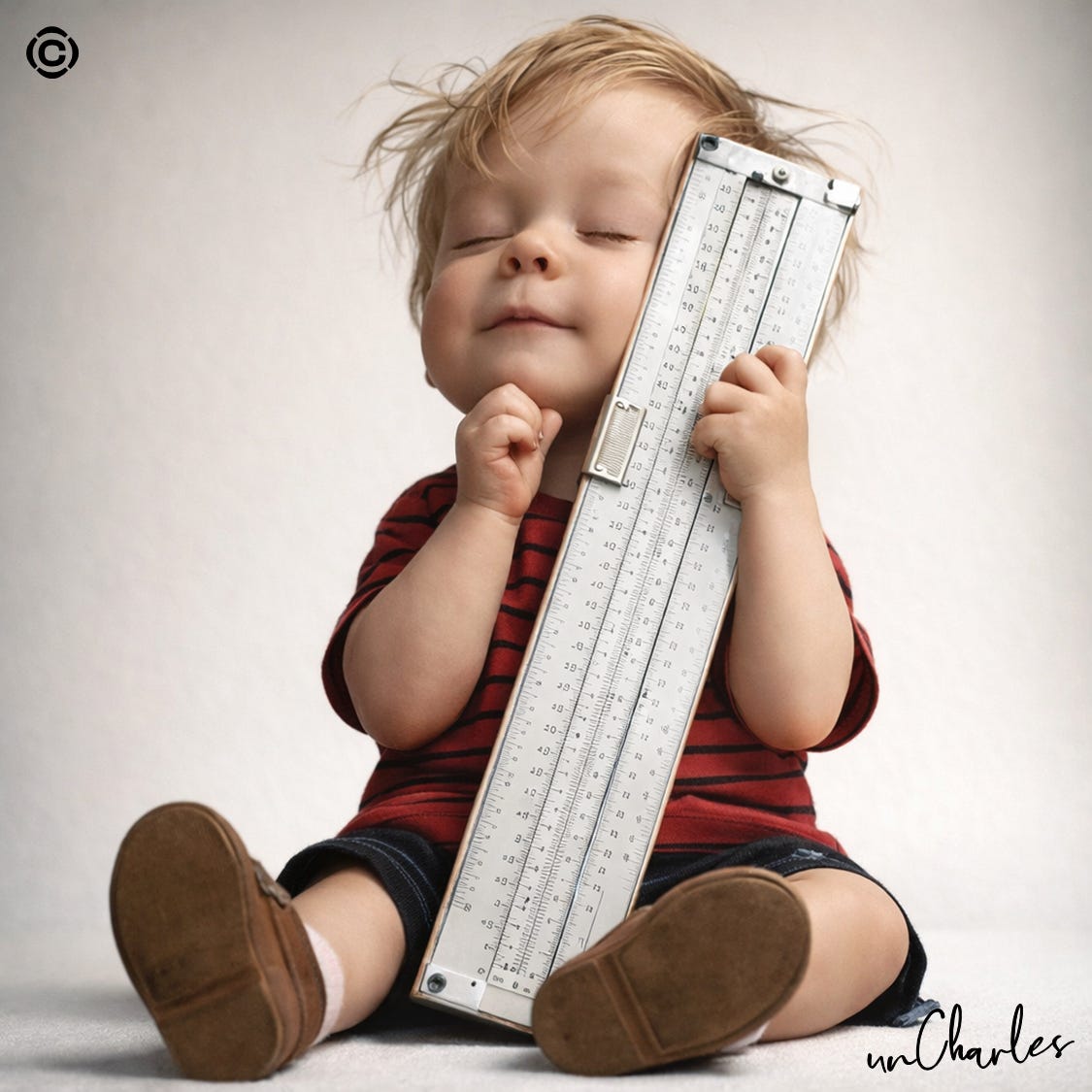
This story starts in my dark age, the mid-1970s. July 11, 1976, to be precise. That was the last day someone made a slide rule. From what I’ve heard, the thing was a marvel of human understanding. You moved wood to find a log. If you don’t think that’s remarkable, walk up to a tree, touch some bark, and see if it does math. At best you’re going to get watered-down baby aspirin—and that’s only if it’s a willow.
Which goes a long way to explaining why my dad tried to show me how to use one. A slide rule. Not a willow. Not just any one. His one. Still stored in a nice red plastic case. That he opened with pride. It gleamed with the kind of shellac they stop making due to—I dunno—climate change. I was unimpressed. A punk kid with an Atari that valued playing Pong over math-infused Lincoln Logs.
Besides, I know 2+2 equals 4. Because, well, it just does. I don’t know how math “works” but—once upon a time—we did. We knew that logarithmic spacing between numbers etched on wood would yield nearly magical results. Here, “we,” means a collective knowledge passed down to create an understanding so deep that we could squeeze nearly unexplainable performance out of it.
We’ve lost the vestigial how along the way. Like how Neolithic farmers built Stonehenge. We can build it now—better, faster, cheaper. Because we’re better than Neolithic farmers. Way better. Our today tools put layers between results and knowledge.
Which is neither sad nor awesome. It’s just evolution.
{
I used to code in assembly language. That’s like saying I could read mnemonic hieroglyphs on a stele. The code to add one to a number was: CLC \n ADC #$01. So, we abstracted it to make it look human: x = x + 1. These days, you can tell Wispr Flow, “Write the plus one code.” All this fancy stuff masks that the computer is still thinking: $18, $69, $01.
No one cares that you have to increment a memory register. Why should they? How becomes irrelevant when you can make things without knowledge.
KNOWLEDGE JUST GETS IN THE WAY OF PERFECTION.
}
Evolution is more than fine. It’s inevitable.
Still too esoteric for you? How about this? I know how to drive a car with a manual transmission. I understand why and when I have to change gears. I understand why my automatic car does that. The next generation will be so abstracted from the hows and whys of driving they won’t even consider how cars became their soccer moms.
It’s fine. It’s evolution.
The problem is we won’t let ourselves evolve.
We’re trapped in a Lucy Bubble.
Here, “Lucy,” is the diminutive hominid that’s beyond the last species and not quite the next one. Anthropologically speaking, this generation is stuck between two versions of humanity. One that wondered how things worked and one that won’t care.
Future We will judge creation for its content, not its humanness. Today’s We won’t let us get there.
I know this drummer. He teaches kids how to master paradiddles. He’s a pro. I think he programmed the synthetic drum track for Salt-N-Pepa’s 1987 hit, Push It. The other day, he heard a funk version of Rush’s Limelight. And he told me he “Loved it.” The next track was a jazz version of Limelight. He wondered who did it. AI. He stopped listening. Not because he didn’t like it. He did. He stopped because—to him—art needs to come from humans. It is, after all, he told me, “How we connect.”
You know what would be nice? A GMO sticker that tells us if content was AI-modified.
Well, Huzzah! There’s a plug-in for Google’s Chrome browser that shows a green and red bar for every song on Spotify. More green means more human. More red means more AI. My drummer friend won’t need to rely on his ears to decide if he likes something. An AI will tell him if he can.
You don’t need an AI-GMO sticker for songs on iHeartRadio. They “guarantee human.” Yep. Their AI pre-checks every song so you never have to worry about listening to an AI song. No appeals.
AI is our judge, jury, and jailor. A, because no one is going to dispute AI’s frontier model justice. And, B, no one can. These services rely on math so convoluted it would make Fourier blush. Who’s going to try arguing a song is human-made with an AI? Me. Because, yeah, I’m that stubborn.
I broke the “red” songs down into component parts. Did AI craft the lyrics? Well, maybe. It’s repetitive. You mean like, “She loves you ya ya ya.”? The melody is too common. Here are 100 songs that rely on the same four chord progression. These aren’t one-hit indie wonders. These are big songs you know. Don’t Stop Believing by Journey. Let It Be by the Beatles. Poker Face by Lady Gaga. So, if the music and lyrics weren’t AI then… what?
Oh, it’s the production. The tool that aligned the pieces too perfectly tainted it.
Pause on that. We don’t like perfection. Because *we* didn’t perfect it. So, only humans get to be creators?
Here’s the delicious irony. We use a thing that makes things better, stronger, easier, and more perfect to define the imperfection in us.
That’s why we scan high school essays for traces of AI. There is a 72% probability that this was written by an AI. What does 72% mean? Three-quarters of the words? Their order? The ideas?
Do you know what 72% means? Where does something as specific as 72% come from? Hallmarks. Flat tone. You know things like, “There is a 72% probability that this was written by an AI.” Or the excessive use of em-dashes. I stopped counting how many it used when it hit double digits. Did I say, “it”? I meant, “I”. Or negative parallelisms. Like—I dunno—”Not because he didn’t like it. He did. He stopped because—to him—art needs to come from humans.”
For all you know, 72% of this story could have been ideated by an AI. Gasp. Maybe I prompted an AI to, “Write an essay in the style of a grumpy Gen X tech blogger complaining about our unwillingness to let AI replace people with perfection.”
But I didn’t. Promise. Like that time in 1981 when I was 14 and in ninth grade and my teacher asked me—pointedly—who wrote my essay, “It was,” he finished in a most accusatory manner, “much better than I could write.” I should point out that I didn’t have access to an array of Cray Supercomputers running on DARPA to solve the Turing Test. I was vibing that project and had an unusually strong want to be perfect that day. I cared enough to put in some effort. I assured him that work product was “All me, baby.” He asked people in the class if they thought I could write that well. They shrugged. Reluctantly, he gave me a C+. The me-ness that strove for perfection got a C+. It went on the fridge. I never took a write-y English class again. I switched to film studies where we watched movies and discussed Orson Welles’ use of ceilings in Rashomon. And no one wondered if I put in too much effort. Because I never did.
Today’s teachers have tools that beat the want for perfection out of kids. At scale. What are we worried about? Perfection? Are we worried that an AI is going to inch Johnny nearer perfection? Imagine what would have happened if Neolithic farmers had put lintels in front of progress? We wouldn’t have pyramids.
For… forever we’ve been striving to better ourselves. Like a C+ on an essay, perfection has been the goal. Not anymore. We’re clinging to our imperfections for some reason.
What’s the solution to perfection? Perfecting imperfection.
So, of course, someone made a service that un-AIs AI-made music. It adds a layer of AI imperfection to rough up perfectly produced AI music. To make it more imperfect. But not more human. We manufacture flaws in funky basslines to establish soul. Go figure.
Maybe it’s about jobs. Here, the kind that auto-deposit pay into your account on the first and fifteen; not the Steve. We’ve heard about AI killing jobs and killing creativity. Pshaw. You’re thinking too small. AI needs to kill a species. Here I mean “kill,” anthropologically. For me, the extinction event can’t come soon enough. We need to get beyond living in a liminal state. The pre-AI species has to end so a new species can love perfection regardless of how it was made.
Here we are, on the precipice of perfection and we don’t want to leave our imperfect garden. How unAdam of us.
We spent millennia abstracting how. Now we’re clutching how like it’s sacred.